Nontoxic Home Readiness Plan: Your Home as the Container for Integration

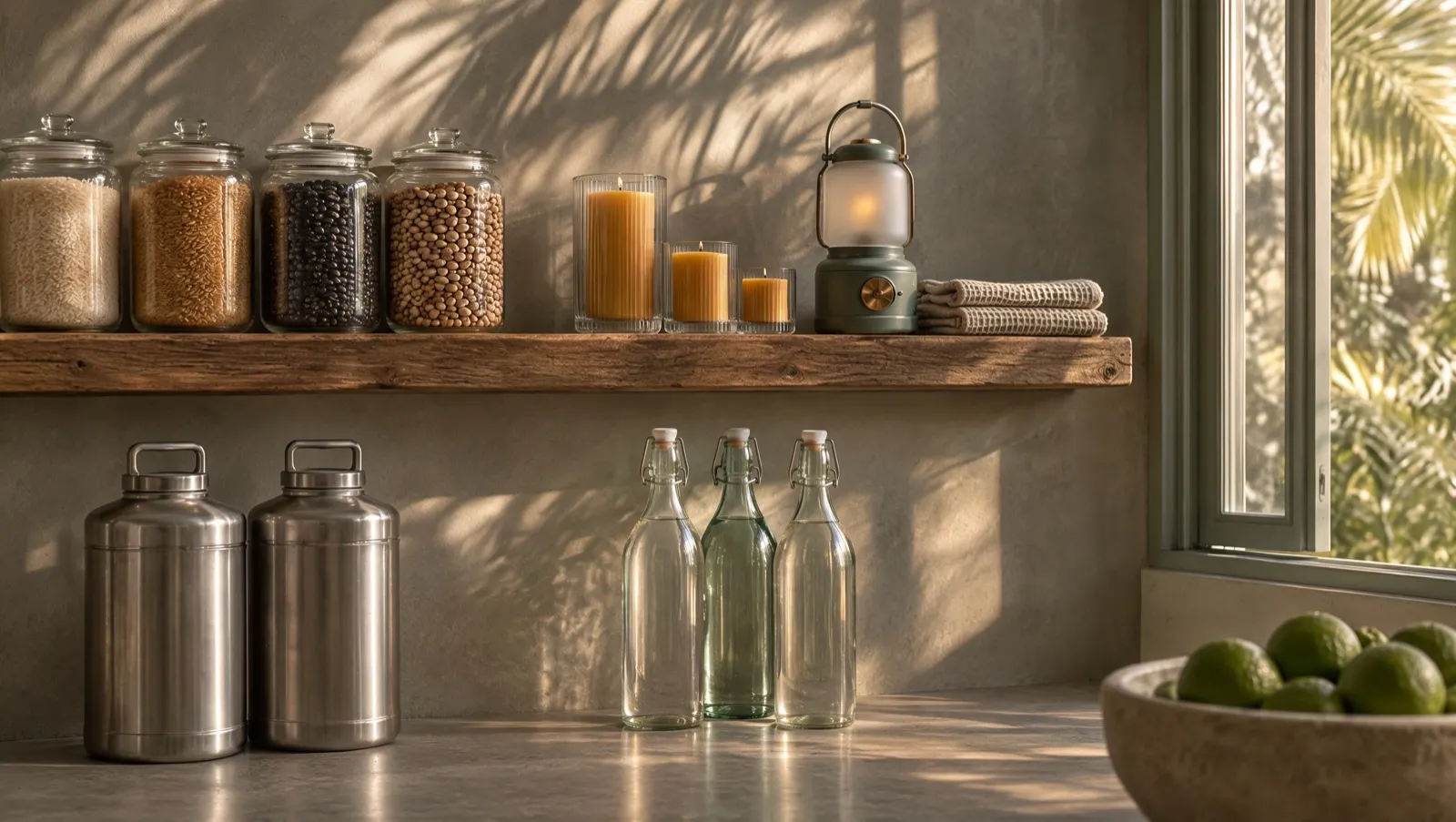
A nontoxic home readiness plan is a room-by-room list of the water, food, power, health supplies, and daily rhythms your household needs to stay safe and calm through a storm or a long outage, chosen with fewer chemicals and gear built to last. At Psychable, we see it as part of integration. Your home is the container you return to after any deep healing work. A resourced home helps resource your nervous system.
Our plan is free, and it lives here: the Psychable nontoxic home readiness plan. Set your household size, and every amount on the page updates for you.
Why we made a nontoxic home readiness plan
We made this plan for our own family. Hurricane season asks every household here the same question. If the power goes out for ten days, are we ready?
We wanted an answer that matched how we live. Clean water in glass and stainless steel. Real food without seed oils. Light that does not fill the house with fumes. A plan that keeps a small child cool, fed, and calm.
When we shared it on Instagram, so many of you asked for it. So we made it public, and we made it free.
What does set and setting mean in psychedelic care?
Set is your inner state: your mindset, intention, and expectations. Setting is your environment: the room, the people, the sounds, the sense of safety around you.
Researchers have shown that context shapes the psychedelic experience in measurable ways. A 2018 study led by Robin Carhart-Harris found that the environment and the person's readiness going in were linked to how the experience unfolded and how people felt afterward (Carhart-Harris et al., 2018). Ido Hartogsohn has argued that set and setting are central to how psychedelics act, never a side note (Hartogsohn, 2016).
Most conversations about setting stop at the ceremony room. We think that is too narrow. The preparation is 10%. The medicine is 30%. The integration is 60%. And most of that 60% happens at home.
Why your home is the container for integration
Integration is how you embody what came through in medicine work, in your daily life. It happens in your kitchen, your bedroom, your morning walk, your conversations at dinner.
After a ceremony, a ketamine session, or an ibogaine treatment, many people feel more open and more sensitive than usual. Sound is louder. Emotions sit closer to the surface. This is often a tender, fertile window. It is also a time when the home either holds you or pulls at you.
A cluttered, chaotic, or unprepared home keeps asking for your attention. A calm, stocked, simple home lets you rest into the work. We think of the home as a sacred container. That is the setting we want every individual to come home to.
How a ready home resources your nervous system
Your body is always reading your environment for safety. When basic needs feel uncertain, the stress response stays switched on. Over time, that constant bracing takes a toll on the body (McEwen, 1998).
Readiness lowers that background load. Knowing there is water, food, light, cooling, and medicine in the house is a quiet signal of safety. You stop scanning. You can breathe.
That is why we built the plan around priorities and calm. Water and medicine come first. Then food, light, and sanitation. Then the slower work of hardening the home and building your neighbor circle. One tier at a time.
Why nontoxic matters in a healing home
Americans spend about 90% of their time indoors, where some pollutants are often 2 to 5 times higher than typical outdoor levels (U.S. Environmental Protection Agency). Emergencies tend to add more: fuel fumes, aerosol sprays, plastic stored in heat.
The plan makes the cleaner choice the easy one:
Drinking water stored in glass or stainless steel, with food-grade plastic only when needed, kept cool and out of the sun.
Beeswax candles and plain olive oil lamps in place of paraffin and kerosene.
Fragrance-free wipes, sanitizer, and odor absorbers like activated charcoal and baking soda.
PFAS-free plates and bamboo utensils.
Organic food in glass jars or BPA-free cans, and no seed oils.
Rechargeable, metal-bodied gear you buy once and keep for years.
Fewer exposures. Less waste. A home you can actually rest in.
What is in the free nontoxic home readiness plan?
The plan is an interactive checklist you can use on your phone or print. It covers:
Water: how much to store for your household, filters, purification tablets, and refill containers.
Food: protein, carbs, produce, and no-cook options, sized to your days plus a two-day buffer.
Power and cooling: lighting, fans, power banks, and carbon monoxide safety.
Health and first aid: 30 days of every prescription, a printed medical list, and a full kit.
Sanitation: a two-bucket emergency toilet, bags, and cleaning basics.
Communication, money, and documents: a weather radio, a printed contact list, cash in small bills, and scanned records.
Home hardening and go-bags: shutters, shutoffs, and one packed bag per person.
For the little ones: comfort items, routines, and simple words to keep a child feeling safe.
Going to 30 days: what changes when an outage lasts weeks.
A storm countdown: what to do 72, 48, and 24 hours out, during, and after.
Set your adults, kids, and days at the top, and the amounts in every list update for you. You can mark what you have, assign tasks to people in your household, and track spending. Everything you enter stays on your device.
How to use the plan as an integration practice
Preparation is a form of care. Here is how we suggest moving through it.
Set your intention. Start with your household numbers. Who are you preparing for?
Begin with priorities. Water and medicine first. Everything else can wait a week.
Take one tier at a time. There is no prize for finishing in a weekend. Steady progress is the point.
Share the work. Give each person a list. Readiness held together feels lighter.
Practice once. The plan suggests a 48-hour lights-off weekend. It shows you every gap, and it teaches your body that you can handle it.
Hold the rhythm. Rise and rest with the sun. One daily walk. A gratitude circle at dinner. As the plan says, the spirit of the house is a supply you store too.
Preparing your home before and after medicine work
The same thinking applies to any medicine journey. Before you go, prepare the home you will return to.
Clean and simplify one or two rooms where you can rest.
Stock easy, nourishing food and plenty of clean water.
Keep your medical list, prescriptions, and important numbers in one place.
Choose one person who knows your plans and will check on you.
Clear your calendar for a few quiet days afterward.
After you return, protect your sleep, eat simply, spend time in nature, and write down what came through. Hold off on big decisions. If you would like guidance, you can find vetted integration practitioners on Psychable.
Frequently asked questions
What is a nontoxic home readiness plan?
It is a checklist of the water, food, power, health supplies, and routines a household needs to get through a storm or a long outage, chosen with fewer chemicals and gear built to last.
Is the Psychable home readiness plan free?
Yes. The plan is free and open to everyone at join.psychable.com/nontoxic-home-plan. What you enter stays on your device. We are constantly updating that plan as new information is coming out. You can sign up for updates if you would like them.
How does home readiness relate to psychedelic integration?
Integration mostly happens at home, in daily life. A calm, stocked, non-toxic home lowers background stress and resources the nervous system, so your attention can go toward rest, enjoying your time with your loved ones, and having peace of mind.
How much water should I store?
Ready.gov recommends at least one gallon per person per day for several days. Our plan uses 1.5 gallons per person per day for drinking and cooking, because South Florida heat raises your needs. Water for washing and flushing is separate.
Do I need a practitioner for integration?
It is highly recommended. A trained integration practitioner can help you make sense of what came up and turn it into lasting change.
Your home is part of your care
Your body is your temple. Your home is the temple around it. When it is ready, you can rest, and when you can rest, you can heal. Safety is non-negotiable, and readiness is one of the most loving things you can do for the people you share a roof with.
Start with water. Start today. Open the free nontoxic home readiness plan.
This article is for education only and is not medical, legal, or financial advice. Psychable is not a medical provider and does not offer, procure, or refer for any controlled substance. Follow the guidance of your local emergency officials, and talk with a qualified medical professional about your health needs and medications. Some links in the plan are Amazon affiliate links. If you or someone you love is in crisis, call or text 988 in the US to reach the 988 Suicide and Crisis Lifeline.
Sources
Carhart-Harris RL, Roseman L, Haijen E, et al. (2018). Psychedelics and the essential importance of context. Journal of Psychopharmacology. https://pubmed.ncbi.nlm.nih.gov/29446697/
Hartogsohn I. (2016). Set and setting, psychedelics and the placebo response: an extra-pharmacological perspective on psychopharmacology. Journal of Psychopharmacology. https://pubmed.ncbi.nlm.nih.gov/27852960/
McEwen BS. (1998). Protective and damaging effects of stress mediators. New England Journal of Medicine. https://pubmed.ncbi.nlm.nih.gov/9428819/
U.S. Environmental Protection Agency. Indoor Air Quality. https://www.epa.gov/report-environment/indoor-air-quality
Ready.gov. Water. https://www.ready.gov/water
988 Suicide and Crisis Lifeline. https://988lifeline.org
Tags
- Integration
- Preparation and integration
- Psychedelic integration
- Harm reduction